the game
Story Mode
eleven chapters called the slow wake. it opens cold, in a skate bowl, with one fox unable to land a line he has landed ten thousand times — and it never once tells you what is at the top of the mountain.
the slow wake
the island runs out of shape
forty years ago a stranger set a marble on the water, rode the resulting mountain down in one long descent, and where the wheels touched, ground came up — plaza at the first push, pool where they carved, pier where they stopped. the island has been filling that shape in ever since at roughly a villa a year.
this season it reached the pier. the line is finished. and a growing thing that runs out of shape either stops, or picks a new one.
so the island is turning over. not waking up — waking toward something, the way a sleeper rolls. it is not hostile, it is not sentient in any way you could negotiate with, and there is nobody to fight. it is weather with a mountain attached.
the stakes are deliberately un-apocalyptic, and therefore worse
if the island stretches with no line to follow, it rearranges. the plaza ends up somewhere sensible. the pier faces a different way. everyone adjusts inside a week, and nobody remembers there was anything to adjust to.
the night janitor, on a break at three in the morning, gets the thesis and nobody else ever says it out loud.
it wouldn't hurt anybody. it'd just put things where it wanted them and we'd all be fine about it. that's the part i don't like.
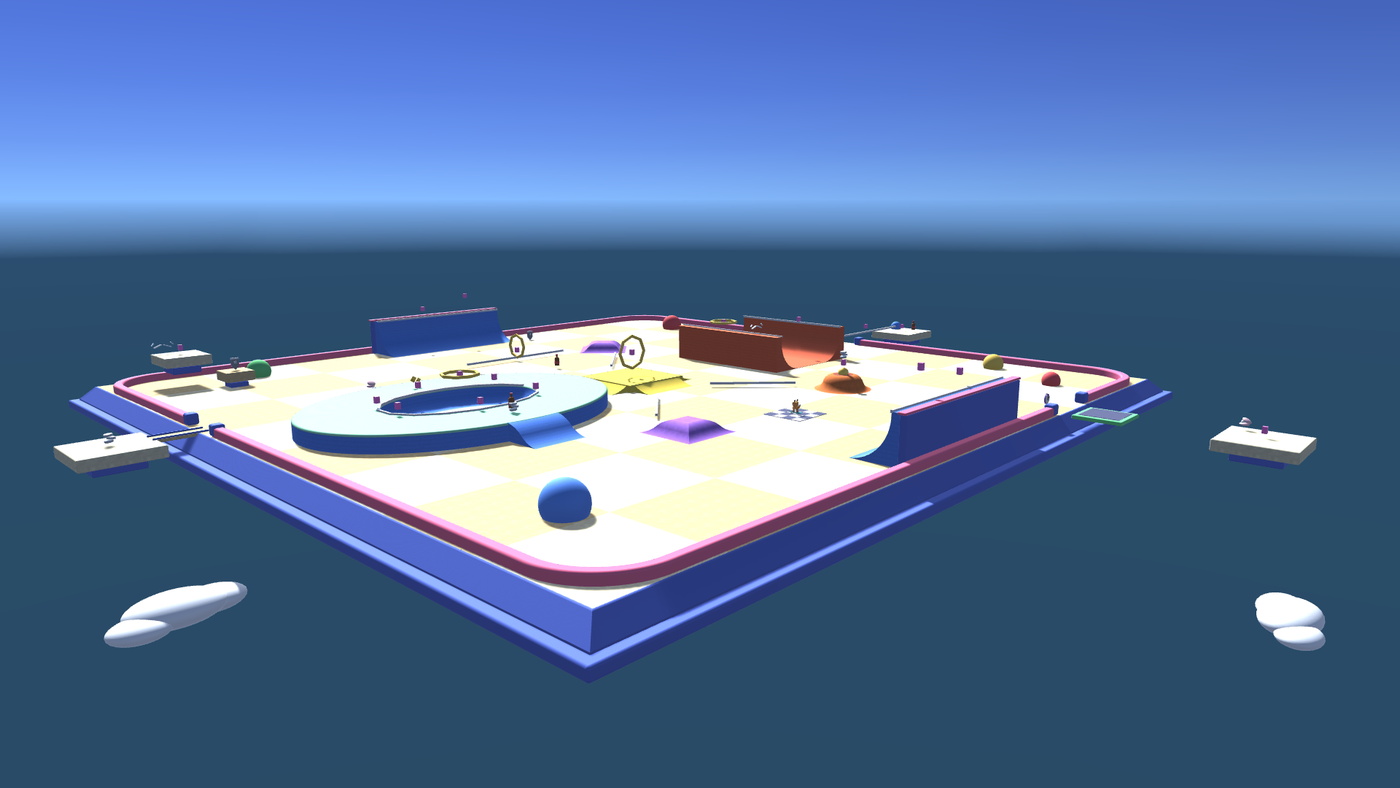
the dramatic question is practical, not epistemic. the ground is moving; what do we do. practical questions can be answered completely, and answering one completely is what makes an ending feel like an ending.
nothing about who built this place, why they left, or whether your arrival was invited is touched, implied, or ruled out. the satisfaction budget was spent on capability and cost.
an editorial decision, stated plainly
what this page holds back, and why
the game has a standing design law called the thirty-four test: no story beat may make any of the thirty-four residents' private theories readable as confirmed or as ruled out. a public guide that answered those questions would undo the exact thing the game spends eleven chapters protecting — and would quietly convert the deepest friendship reward in the game into a collection of errors.
so this page does what the game does. you get the premise, the structure, the argument for why each chapter is set where it is set, and the laws the whole thing runs on. that is genuinely the most interesting part, and it is craft rather than plot.
what is here
- the premise, in full — it is the first line of the first chapter and the game does not treat it as a secret.
- all eleven chapter titles, the act structure and the order rules.
- the vessel argument: which venue carries which chapter, and why that genre and no other could carry it.
- what each of the seven foxes wants.
- the design laws, including the audit that enforces them.
what is not
- the thirty-four theories. they are the top friendship reward; go and earn one.
- the six deep secrets the residents carry at tier three.
- the cutscene scripts, and every line of the last three chapters.
- the list of what is permanently different afterwards. there are eighteen of them and finding one is the point.
- any answer to the three questions. we do not have one either. nobody does, on purpose.
the caretaker of this island has never had a line of dialogue and never will, here or in the game. we are not giving it one.
structure
tight, then loose, then tight
every chapter is entered by walking somewhere in an open world. there is no chapter select, no mission board handing out jobs, and no arrow.
two beats, in that order and only that order
a thing goes wrong in one bowl, and then somebody counts how much of the island it covers. no wandering and no menu. chapter three finishes the act out in the open world and takes the leash off.
order-free within each act
five chapters spread across the venues and all three enclaves, taken in whatever order you find them. you can wander, and the story waits. every gate reads a flag rather than a chapter number, so the world simply is what it is when you get there.
strictly linear again
a decision, a climb and a descent. by this point the game has stopped offering you alternatives, which is the correct shape for an ending.
permanent free roam
the camera is handed back on the last frame and never taken again. nothing re-locks, ever.
the no-locked-out-saves law
the story never asks "did you just do X." it only ever asks "is X true now."
on every scene load the game derives an evidence set from your save, raises your chapter to the highest one that evidence supports, back-fills the flags those chapters would have set, and marks their cutscenes played — except one short catch-up scene, which waits for your next arrival in the hub. it never lowers anything.
so a player who had already beaten all seven venues, the badge chain and the hundred summit levels before story mode existed loads into chapter ten, gets one dry catch-up scene, and goes straight to the vote. no venue is ever re-required. cleared venues retro-count as survey data, and what a veteran gets instead is a short remixed run per venue that is new content, gated behind a flag, and skippable. the fox joins on arrival either way: "you've beaten me here. i remember. this one's different. the ground's the one taking the run."
and the story never takes a mechanic away from you. what the foxes give up is fiction, not a nerf: afterwards all seven are still playable, all seven abilities work exactly as before, and power-ups spawn more widely rather than less. every world change is additive, every flag is one-way, and exactly one thing in the whole story is permanently missable. it is cosmetic, and nobody in the fiction mentions that it did not happen.
the eleven
every chapter is set where only that genre could carry it
this is the design spine of the whole thing. the game already contains seven complete games in seven genres, and each genre is good at exactly one kind of story beat. a score attack is the genre of repetition and mastery. a racer is the genre of the fixed route. a board game is the genre of declared turns. the story goes where the argument goes.
a finger's width
trick park · score attack
the coping has moved a finger's width, maybe less, and the fox who has landed one particular link ten thousand times cannot land it today. score attack is the only mode in the game that manufactures a player with a memorised line, which makes it the only place where two inches of geometry is a scream. it needs no exposition either: a fox misses a trick, on ground you can see. that is the entire setup.
the audit
the hub · the activity board
somebody takes the number off chapter one and reads your activity board against it. not to congratulate you — to count. this is where the story reads your save, which makes a veteran feel seen and a new player feel tracked, and it lands harder in second position than it would have in first, because by now you have already felt one thing be wrong before anyone started measuring.
forty seconds of straight
grand prix · kart racing
mid-lap, the loop opens. forty seconds of road heading inland that was not there on the previous lap and is not there on the next one. racing is the genre of the fixed route: a track is a promise that the corners stay put, and a lap is your own proof of that promise. in any other venue, new ground is content.
one leg per tide
turtle cove + the rumble ring · platform fighter
the cove holds the middle of the story and will tell you at cove speed, one leg per tide — so the shipped day and tide systems become story structure, with testimony arriving across real in-game days. interleaved with it, a percent-knockback fighter is used as what it actually is: a machine for quantifying resistance. somebody loses their own argument in their own building, numerically.
two ends of a line
gull roost + otter docks
only fliers can trace an overhead line across ground that has been built over for forty years, and only divers can read an island from below the waterline. both are species capabilities no fox has, which is why no fox solved this in forty years — they only ever asked each other. you follow a courier's flight through the entire resort on rails and gaps, then go down the island's flank with a pearl diver.
half-made
creature skies · catching
a catching game is the genre of the complete set, so its own collection interface becomes the alarm: a completion screen reporting an entry that cannot exist is a horror available in exactly one genre in this build. the chapter also quietly reframes catching as care — the fox running it is not collecting, she is holding things steady until the ground settles, and correctly, nobody says that out loud.
six pieces of one line
the classic · 2d platformer
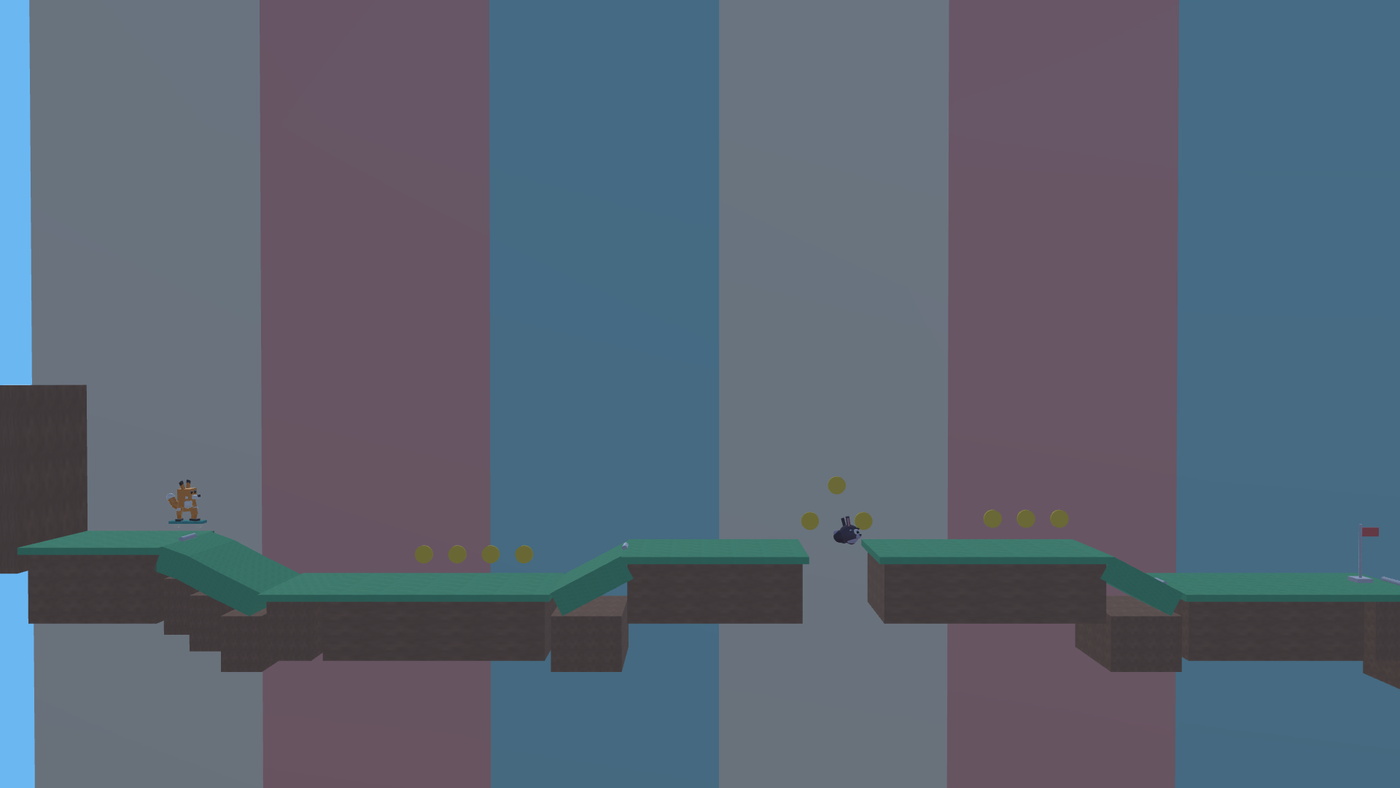
the best argument in the document. a side-scroller is a side elevation — a cross-section, which makes this venue a drafting table by construction, and the arcade cabinet has been holding an accurate profile of this mountain since before the arcade existed. and in a side-scroller everything already is one continuous line, which hands straight to the finale. each level you clear lowers that segment of the profile into the real hillside outside, so by the end of the chapter six pieces of the descent physically exist as ridable ground.
seven yeses
the national park · creature rpg
two shipped systems get repointed and neither gets rebuilt. the eight power-up-gated biome tiers stop being locks on you and become trail clearing — you are not proving you may pass, you are making the tier passable for a crowd that is slower than you. and the badge chain becomes a consent mechanic: the seven gym leaders were already the seven foxes, and each gym battle is that fox's answer to one question. the badge is the receipt.
the vote
shadow board · party board game
seven foxes, one table, one decision that costs each of them everything they are known for. they do not agree. a board game is the genre of declared turns and agreed rules — the only venue in the build where seven people can sit down, decide something, and be held to it. the tiles rearrange mid-game because the island is moving under the table, which is the theme literalised in the board's own mechanic at zero cost. you win or you lose; the plan carries either way, because this is a vote and not a boss.
the climb
summit trials · marble platformer
a hostile surface, precisely traversed, carrying something you cannot drop. that is the entire chapter, and a marble platformer is the genre of exactly that. the route climbs to a shelf below the top and stops there, because the line starts below the top — and in a marble game a wall is not a tease. a wall is the level.
the second descent
all seven, as terrain
the structural payoff of the whole design: the finale is not a new level, it is the venues turned into ground. one continuous ride, no cuts, no fail state — a slower line is just a slower line. the floating sky park lowers onto the mountain's flank and its coping ring becomes a real bank. the ring road is held straight for one run. the six lowered segments connect into hillside. the trails you cleared at a turtle's grade are how everyone else got up there to watch.
why that argument matters more than the plot
a game that contains seven genres can either tell a story over the top of them or tell one through them. this one does the second, which is why the venues do not read as a menu of side content with a narrative bolted on.
the test each chapter had to pass was blunt: if the beat could have been staged anywhere else in the build, it was staged in the wrong place.
the cast
who wants what
seven foxes, each of whom is asked for the only thing that makes them special. they do not all say yes for the same reason, and one of them votes against the plan and then rides point on it — which is the most this game will ever say about loyalty.
Paolo
he has spent twenty years pretending not to notice that everything lands twenty-five percent sweeter around him. giving it up is him finally testing whether he is good or just lucky — and the game never tells him, or you, which it was.
Dash
the story's dissent: the one fox who would let the island rearrange the entire resort if it bought her a straightaway. she has lapped this island more than anyone and has never once finished a race, only stopped.
Boulder
his answer to a moving island is to pin it. he loses that argument numerically, in his own ring, and then finds his real job on the mountain. "turns out i'm ballast. i'll take it."
Skye
she reads the whole situation as an animal-welfare problem, which is the correct read, and nobody tells her so.
Spring
she grew up flat and refused to accept it, and she is the only fox who can read a cross-section back into a mountain. she drafts the plan in chalk. she is also the only character allowed to say "this'll work" instead of "this might", once, and never again.
Umbra
he calls the audit and runs the vote, and steps out of the room for the one minute in which something happens that he will not be asked to explain.
Rollo
he came down that mountain humming the note it hums and has never been to the top. the humming was loudest lower down, which is not the same thing, and nobody has ever asked him a direct question about it.
the enclaves are not quaint
gulls are brisk and smug, turtles are slow and unimpressed, otters log everything. they are not wise elders dispensing lessons to foxes; they are professionals with better data, and they hold three parts of the answer between them because they were watching from three angles no fox had.
none of the three wants to be invited and none of them wants to be thanked. the roost wants the delivery to go out on time. the cove's price is not a favour and not an apology — it is four hours of a kelp course, sat through, by somebody senior.
the player
no splinter, no power, no shift, no job. which makes you the only resident who goes everywhere, and therefore the only one who can hold a survey that spans four species, seven venues and a mountain.
the story does not say the last piece was meant for you and does not say the island chose you — it pointedly establishes that the thing sat unclaimed in a lost-property box that anyone could have opened for eight years. the player never speaks. their dialogue is an ellipsis and the things they do.
the hard law
the thirty-four test
no beat ships if a reasonable player, having seen it, would score any of the thirty-four theories as ruled out — or as confirmed.
every one of the thirty-four residents hands over a personal theory about the island's founder as their top friendship reward. they contradict each other. a confirmed answer would retroactively make thirty-three of them wrong and convert the game's deepest reward tier into a collection of errors.
so the rule is not a tone preference, it is an economic argument about a system that is already built and already playing — and it outranks any individual scene, including good ones. it is run as a literal checklist against the shipped character file, and it is checkable by somebody who did not write the beat, which is the entire point.
four enforcement clauses
hooks deliver objects, never facts
the game holds ten hooks pointed straight at the mystery. the permitted output of one is a thing that exists: a place, a sound, an object, a prompt, a new piece of ridable ground. the forbidden output is a thing that is true about the founder.
no beat may prove a question unanswerable
proving that no source can ever confirm is itself a finding, and it kills a mystery deader than an answer does — a theory that can never be true is functionally ruled out, and a player who knows the search is structurally impossible stops playing for it. so sources fail the way they always failed: quietly, individually, without anybody drawing a conclusion. nobody in this game ever says "we'll never know."
the mystery only ever loses ground to a player-pressed refusal, at zero information
at every terminus that gets close, the prompt appears with the ask option removed and one input on screen: LEAVE IT. you press it and gain nothing. withholding by the author reads as a cheat done to the player; refusal by the player reads as a choice they made, and it makes the mystery theirs to keep rather than the writer's to guard.
the caretaker never speaks, and the summit is never a destination
no cutscene routes to the summit, no cutscene camera frames it. the caretaker's entire grammar is finished and unfinished chores — a half-raked trail, a rake propped exactly where a gap needs measuring, a lamp lit that nobody lit. it has zero lines, forever, because a shadow with a speaking part is a shadow that will eventually be asked a question.
the best image in the document was cut from the script for this. there is a seam in the rock at the top of the mountain, and if you hum at it, it hums back. it was too good to spend inside a cutscene, so it was moved out of the story entirely: after the climb it exists in free roam, unmarked, with no character present, no dialogue afterwards, no flag written, no log line and no achievement. it hums back every time, forever, and produces nothing else.
it becomes a thing a player finds alone and tells their friends about, which is stronger than a thing a fox watched them do.
no carve-outs were taken. not the caretaker's one implied sentence. not the oldest fox's next word — his sentence dies at the same word it always died at, nobody theorises about why, and nobody frames the failure as meaningful. and not the ferry: the timetable is unchanged by the ending, nobody remarks on it, and the story says nothing whatsoever about the morning your boat found the island on the first try.
the tone law
nobody in this world raises their voice
lowercase, always
character names lowercase in dialogue. no exclamation points, ever, from anyone. an editor-time validator fails the build on one, on an all-caps word, or on a flag name that would imply an answer.
stakes are real; volume is not available
a villain who monologued would break the game on contact, which is one reason there is no villain anywhere in it — not in the story, not in the antagonist subplot, and not behind the range.
feeling is an object or an action, never a declaration
a coping that moved a finger's width. a rake propped exactly where a gap needs measuring. a slip kept free for forty years. if a line states an interior state out loud, it gets rewritten as a thing somebody did.
the spring ceiling
the most enthusiasm any character may express is "this'll work" instead of "this might." exactly one fox is allowed to reach it, once.
no contrition
this cast cannot apologise and cannot ask to be included. nobody says thank you for being watched, nobody begs to be needed, and there is no hug line.
short
cutscene lines target under fourteen words. two-line exchanges beat four-line ones. and the foxes never explain the theme — if a scene's thesis has to be said out loud, the scene is staged wrong.
after
the island does not go back to sleep
a reset would make the whole premise a scare. so it stays awake — it just has somewhere to go while awake. awake and pointed is fine.
you are left standing in the plaza at dawn, in free roam, with everything unlocked and the camera already handed back. eighteen things about the island are permanently different, and this page is not listing them, because half the pleasure is rolling past one three hours later and realising it was not there before.
what can be said about the shape of it: nothing is taken away, nothing re-locks, every change is additive, and at least three of the new places are reachable, permanent, and arrive nowhere at all. no character in the game ever connects any of them to anybody's theory. they are ground, and that is all they are.
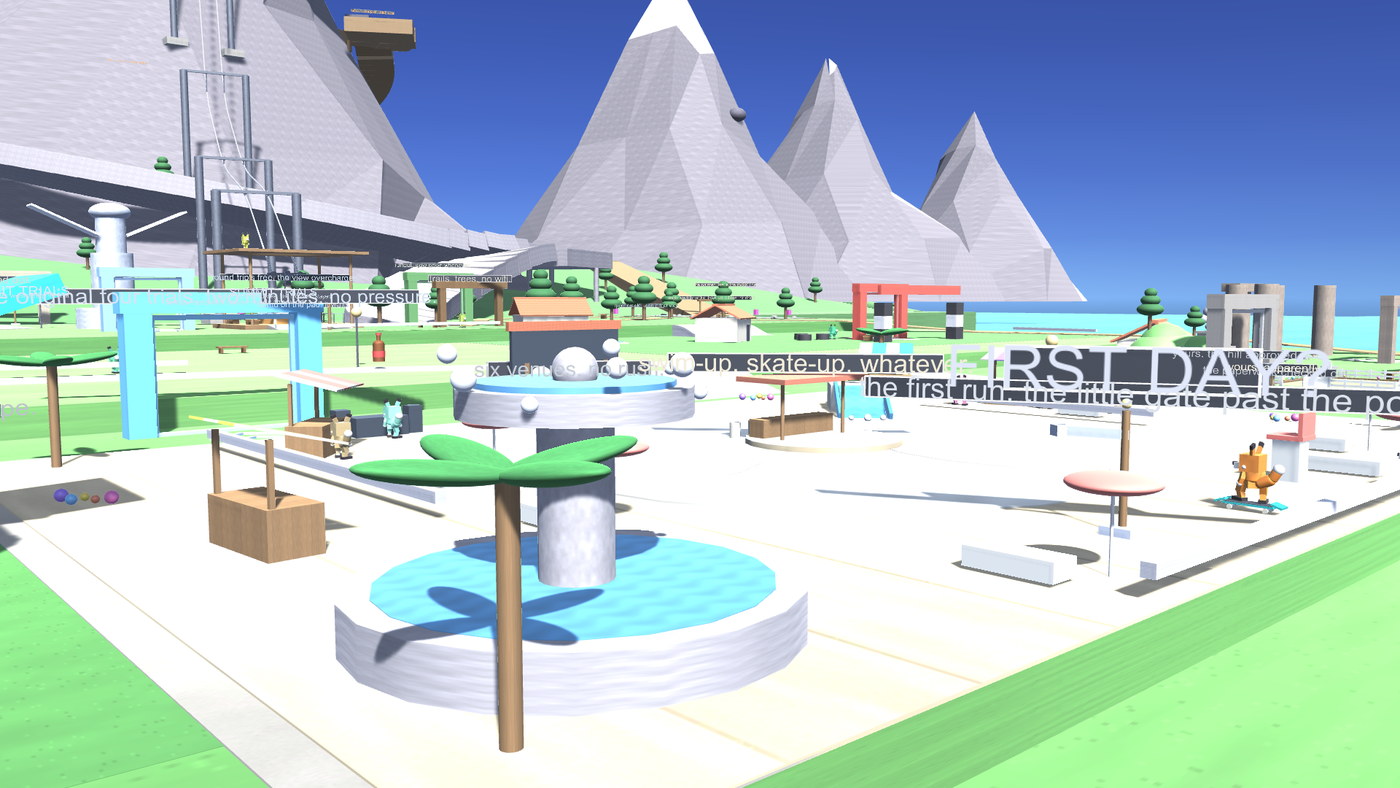
the seven foxes are free to leave afterwards. none of them do. each has one line about how leaving is possible now and boring. that is the found-family ending, and it is one this cast can survive having, because nobody ever says it.
all thirty-four residents get one epilogue line about what happened. not one of them mentions the founder — they talk about the road, the tide, the noise, the new stairs, and their own jobs. the thirty-four theories are untouched and still gated at friendship eight.
under it
how it is built
cutscenes are data, not scripts
a director plays a list of beats built by a fluent builder. a chapter is a method that returns data, and chapters self-register with the library — so adding one touches no generator, no scene and no switch statement.
the actor layer sits above the animator, never inside it
cutscene poses are additive over the normal fox animation. nothing is destructive, so a scene that is interrupted, skipped or fails cannot leave a fox stuck in a pose.
one arbiter takes the controls
a single lock decides who may stop the player, and it applies the fields itself from the union of everybody currently holding it. the older idiom — remember the value, set it, put it back — produced five separate proven soft-locks, each one found inside the fix for the previous one.
triggers, and never re-firing
chapters are entered by walking into a zone. zones read flags, flags are one-way, and a played scene is marked played. you cannot fall back into a chapter you have finished.
reconciliation on every load
the save is re-read from scratch and progress is derived, never trusted. it never lowers anything, and it back-fills rather than replays — see the no-locked-out-saves law.
validators at compile time
an editor-only pass walks every line of dialogue in the game and fails on an exclamation point, on an all-caps word, or on a flag named in a way that would imply an answer. the tone law is not a review note; it is a build error.
the systems underneath all of it → · the seven venues in depth →
the list
tell me when it ships
one email, when there is something to play. no newsletter, no schedule, nothing else, ever.